
Project 2 – ZFG & Aspheric Media P1
- Dec 3, 2016
- 8 min read
ZFG currently consist of three members, Jordan Fonua, Kudzai Johnson and myself. The group started off as an idea in trimester 1, in CIU 110. Two young audio students, fresh out of high school, ready to chase our passion of music. Ever since then, ZFG has continued to grow in theoretical and practical knowledge, understanding to always take on the student mentality and never outshine the masters. There have been many ups and downs during the production and recording stage but we as a group don’t allow that get us down and give up.


“Think of it this way: There are two kinds of failure. The first comes from never trying out your ideas because you are afraid, or because you are waiting for the perfect time. This kind of failure you can never learn from, and such timidity will destroy you. The second kind comes from a bold and venturesome spirit. If you fail in this way, the hit that you take to your reputation is greatly outweighed by what you learn. Repeated failure will toughen your spirit and show you with absolute clarity how things must be done.”
― Robert Greene, Mastery
ZFG have focused only on providing freestyles, verses and hooks for royalty free music found online, focusing on developing lyricism, wordplay and melody. For this project, we decided to take on the challenges of creating an original piece of music, moving out of our comfort zone and reaching out to the world of Hip-hop/Rnb and creating a name for ourselves. It was inevitable the challenges we were to yet to face and have already faced would only get harder but make us stronger and more efficient and we are prepared for that. Having a strong bond with my group members, we all have maintained constant communication from the project-related discussion as well as personal developments and sharing insights. Because of the trimester difference and class differences it has been difficult to be completely engaged in this trimesters project, as Fonua is in trimester 2, he has his own workload and assessments he must complete however we have a mutual understand of each others situation and have helped each other where possible, whether it be production and vocal techniques I have learnt from my class, or his vast background knowledge of funk, jazz and ‘old-school’ music production sounds and research of great artists and their workflows. We believe sharing knowledge is crucial for our development as young artists.
Several import learning events and issues that occurred during the project were mainly due to the lack of knowledge for original music production. Learning the basics of Pro Tools has come a long way, however, it was only until this trimester, I forced myself out of my comfort zone to create an original piece understanding that you have to put yourself and your music out there and be able to take on constructive criticism and act accordingly. Having a strong supportive community at SAE, made it less confronting to show my first original piece of music. Having no previous knowledge of the process, only being an avid listener and curious enough to do my own research into the way artist that I’ve listened to for years, make something so complex yet simple that resonates with you beyond words can describe. However sometimes you just can’t get into the ‘creative zone’ and I’ve experienced this many times, trying to make something that was good to listen to but also something that I would be proud to say “we made that”.
The mitigation strategies can only go so far, there is never a foolproof plan to create an absolutely, smooth sailing template or routine for a project. You have to treat every project as an individual, learning to be flexible and adaptable is what I believe is one the major key aspects to mitigating negative events. In particular, for this project, there were many times where I felt like trashing the whole session and just going back to laying vocals over a ‘Joey Badass type beat’, blogging about the process was the last thing on my mind, it would only make the reader depressed, is what I thought. There’s a lot that goes on behind the scenes for any project. Reflecting on the process it crucial but also there are something that you rather not share. Growing up listening to all these artists, you hear some stories of how they overcame their struggles, probably living in Compton or having to eat sardines for dinner. Despite their struggle, they still managed to do what they love and create good music.
In the situation I’ve been brought up and schooling, they teach you about great masters like Einstein, Shakespeare, Mozart or Da Vinci, but never the story of their struggles and how they put in 10,000 hours of practice in their craft which got them their place in history, (maybe they did, I usually was the one in the back with a pair of earphones pretending to listen). Usually, throughout school, we are subject to accept that these masters were born with a god given talent or right to make their mark in history. It was not until I discovered Robert Greene’s Mastery, which is a book that talks about masters throughout history and their stories or struggles and never giving up despite what seemed like all the odds were against them in the beginning.
For future projects, I would like to spread out the workload evenly with my members, have followed a more detailed pre-production plan but also be able to quickly adapt and work with things that don’t end up being completed on time.

Reflecting on Production Techniques
The production techniques used for this project were very basic and as a group, we decided not to spend any money until we are absolutely sure we require some piece of software or equipment. What we had to work with was the resources provided at SAE and our own personal equipment. I currently have a Pro Tools native perpetual license and work with royalty free sample packs that have been given to me or downloaded online as well as my own samples recorded on a Zoom H4N.

I also own a Casio 88 key, velocity sensitive full weighted keyboard which can be used as a MIDI controller. Being self-taught in piano and having some very basic music knowledge I decided to plug in my keyboard and play instruments in GarageBand. Pro Tools doesn’t offer many free instrument plugins apart from xpand2 which is very basic and doesn’t allow for much manipulation of sounds, therefore, Pro Tools was used mainly as my mixing and arranging DAW however some MIDI was played using xpand. Initially, I will open up an instrument track in GarageBand or Pro Tools’ Grand Piano and play to a click track, much like Noah ‘40’ Shebib’s workflow where he will first play some keys to a click track then create drums around that. This workflow is quite different to most Hip-hop producers as they will start with drum programming or sample chops first. To avoid any copyright issues, I decided to stay clear from samples for now and work with what I have. Obviously, the sounds in GarageBand are limited and basic but, you have to start somewhere so I decided why not use what we have available at home.
For my first track, I used Ableton’s Operator, subtractive synthesiser, at SAE to replace the already existing xpand bass-line to add more grittiness to it and achieve the sound I was going for in my reference track as well as smooth glides between notes. (YouTube). However, after bouncing the file out of Ableton and into Pro Tools, it felt somewhat out of place and further processing had to be applied, I just didn’t know what, also another factor of being inexperienced in music production. Seeking help on YouTube and Lynda, it was apparent there was still a lot to learn about what Pro Tools can and can’t do. In the future, I would like to become more competent in using Ableton and Pro Tools together as a part of my integrated workflow to speed up productivity and enhance creativity. Further studies and Lynda tutorials have proven effective in educating myself in using these DAWs to their full potential however all can not be learnt in a Trimester.
For the second track I decided to take a different approach, instead of using samples and aligning them on the grid, I decided to play the instrument in GarageBand first then bounce it out as an uncompressed AIFF file and place it into a Pro Tools session and work from there. For the second track, I decided to try to follow Noah Shebib’s style of Marvin’s Room, where he places the music in the low end so that the artist (Drake) has all the highs and mids exclusively to himself. To achieve this, 40 degrades the sample rate using Avid’s Lo-Fi plugin instead of using an EQ to roll off the top end. He describes it as making it sound authentic and sampled from somewhere. I tried to achieve the same style, playing some piano chords layered with some noise, then re-arranged, chopped up and degrade the sample rate. Apply this technique gave the same 40 feel, the only thing that was missing was the vocals.
The first vocal session was in the Audient 8024, using the Avalon VT737 Channel strip and Rode NT2A Large diaphragm condenser microphone. Using outboard gear is something that I want to expand my knowledge in and also being able to run all my tracks down the desk to use the desk’s EQ and analogue warmth that you can’t with digital gear. Derek Ali, Kendrick Lamar’s producer, is a strong believer of creating amazing sounds with outboard gear. He is also very educated and experienced in microphone choices, placement and recording. I wish to incorporate both 40’s and Ali’s workflow styles into my own and continue to grow and learn as a producer and engineer.
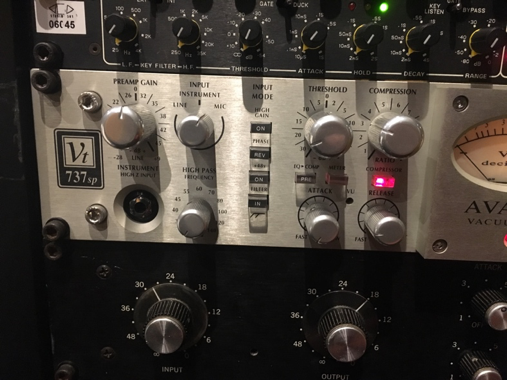
The Avalon VT737 Channel strip is a famous piece of hardware that has worldwide recognition and comes in at a healthy $2,475 US dollars. The gear features a combination of Tube Preamps, opto-compressor, sweep EQ, output level and VU metering in a 2U space. The Channel strip can also flip the EQ to be either post or pre-compression.
Below are setting we used for soft and hard compression with post EQ, VU metering compression.

The microphone used was the Rode NT2A which is a common large diaphragm condenser that is used by professional artist and common among semi-pro artist. The microphone is capable of three polar patterns, we decided to use the cardioid pattern as the proximity was something we wanted to use for a creative purpose to emphasis the low-end during the quitter section of the track.

Project plan guide and teamwork
The original project plan was consulted thought out the project time frame however many changes and issues occurred due to lack of experience and familiarity of the studio workflow and also the artists having no prewritten verses or hooks and where made up on the stop during the studio session. For future projects I will be a necessity and a predecessor for the verse to be written first before the studio session if a freestyle verse is not suited to the track. The workflow of the artist graphic designer and recording engineer. During the studio session, I had the role as the live room engineer, DAW operator and mixing engineer as well as in charge of the arrangement. I had to set up the microphone and headphone mix for the artist for them to get into their creative zone and begin to write. As for the graphic designer, He had to listen to previous works of ZFG to find some sort of visual aid that would appeal to the style of the genre and arrangement of the tracks. Working with Liam Wilson as the graphic designer proved to be very effect with many concepts and works being suited to the style of our project.


Resources:
http://www.avalondesign.com/vt737sp.html
https://www.studiospares.com/Microphones/Mics-Condenser/Rode-NT2-A-Condenser-Mic-Studio-Pack_417010.htm
https://www.youtube.com/watch?v=Dp99hegNewo
https://www.youtube.com/watch?v=cDXJ-1YyswQ
https://www.youtube.com/watch?v=cIWk9WjAU7M
Comments